
Advancing the Next Generation of Scoliosis Care
Rady Children’s Hospital-San Diego recently recruited Michael Kelly, MD, to its nationally ranked Orthopedics and Scoliosis Center — a move that strengthens one of the country’s leading programs for treating spinal deformities in children. A feature in Nature spotlights Dr. Kelly, director of scoliosis and spinal deformities at Rady Children’s, and the work underway to change how this spine-twisting condition is understood and treated.
A Different Challenge in Growing Kids
Scoliosis most often emerges during a child’s pre-adolescent growth spurt, and the majority of cases are idiopathic, meaning they appear with no identifiable cause. Because the characteristic S-shaped curves develop while the spine is still growing, treating children is fundamentally different from treating adults. For adults, spine surgery is largely about relieving pain; for a child, it means managing a condition that can stay with them for the rest of their lives. That is why dedicated pediatric programs like the Spine Center at Rady Children’s have become leaders in both care and research.
Two Approaches to Straightening the Spine
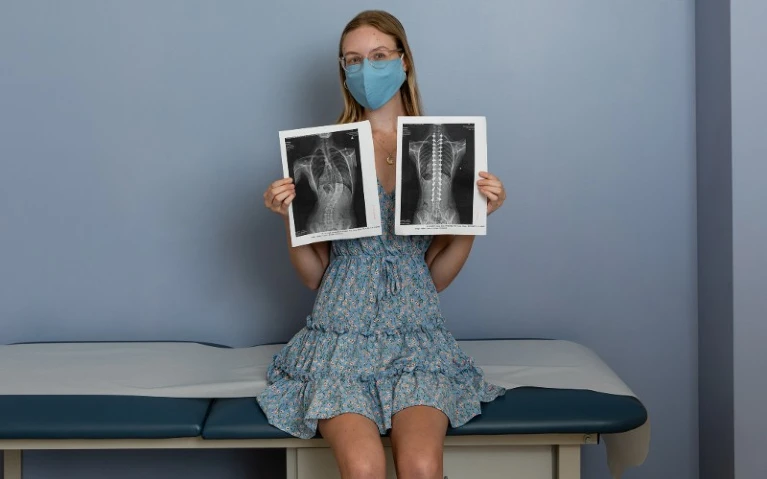
For severe curves, the long-standing standard is spinal fusion, which joins the affected vertebrae into a single solid segment using bone grafts, rods and screws. It is highly effective but technically demanding, requiring a deep understanding of the spine’s three-dimensional shape. Surgeon-in-chief Peter Newton, MD, who has spent more than 25 years advancing scoliosis care at Rady Children’s, helped pioneer an alternative: vertebral body tethering. Rather than fusing bone, surgeons anchor a flexible cord along one side of the spine to guide growth, gradually straightening it while preserving the natural motion that fusion removes. Roughly three out of four tethering patients avoid fusion altogether, though a smaller share may still need a follow-up procedure — one reason the team keeps refining how it identifies the right candidates.
Imaging, Genetics and the Road Ahead
To track how a growing spine responds over time, Newton’s team relies on the EOS orthopedic imaging system, which captures full-body, upright X-rays at far lower radiation than conventional scans. Looking further ahead, the team is partnering with the Rady Children’s Institute for Genomic Medicine to search for genetic markers of scoliosis, while Dr. Kelly explores how immunology and artificial intelligence could one day standardize surgical planning — helping patients receive the same high-quality care no matter where they live.
To learn more, visit the Spine Center at Rady Children’s Hospital.