
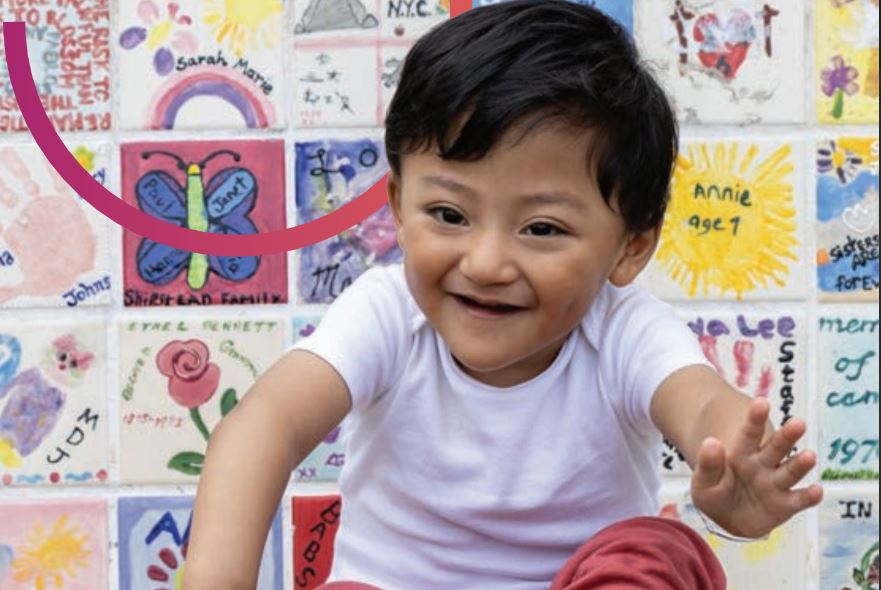
The majority of Blanca Cortez’s pregnancy could be described as uneventful. Ultrasounds showed that baby Amir was developing normally, and no serious issues were detected. “Amir’s dad was the one who was nauseous,” Blanca jokes.
At 24 weeks, everything changed. Blanca was rushed to the hospital and gave birth to Amir. She didn’t even get to hold her new, tiny baby before he was whisked away and placed in an incubator.
“That wasn’t a good feeling, seeing our baby so little with lots of tubes all over his body—that was the first time I cried,” Blanca says. “I never thought that he would be born premature. I wasn’t expecting that, I wasn’t prepared for that.”
Because Amir was born so early, he was at risk for numerous complications. And soon after, he developed hydrocephalus, a condition in which cerebrospinal fluid accumulates in the ventricles of the brain, causing swelling. He was then transferred to Rady Children’s Hospital in San Diego and admitted to the neonatal intensive care unit (NICU).
In Good Hands
Rady Children’s is home to the only Level 4 NICU in San Diego County, meaning its staff is prepared to care for the most premature and critically ill infants. The Hospital’s 60-bed NICU is staffed by a large multidisciplinary team that includes neonatologists, advanced practice providers, therapists, dietitians, social workers, and neonatal nurses.
Rady Children’s is also the major referral center for the most critically ill newborns, many of whom suffer from severe heart and lung conditions or are born extremely premature. The Hospital’s neonatology program is consistently ranked among the top 10 in the country by U.S. News & World Report.
Amir was in good hands, but he wasn’t out of the woods yet. Because he was so tiny, he had to reach a weight of just over 6 pounds before he could undergo surgery to relieve the swelling around his brain.
“Watching him struggle to breathe and seeing his head get bigger and bigger were some of the hardest moments during our hospital stay,” says Blanca. “I felt devastated thinking the worst could happen due to his very premature age. But I was hopeful.”
Amir required immediate subspecialty care, explains Jeanne Carroll, MD, medical director of the NICU at Rady Children’s and an associate professor of pediatrics at UC San Diego.
“When premature babies are first born, they typically need support for all their major organs—support for their heart if they have low blood pressure, help to regulate their temperature, and IV nutrition because they can’t tolerate food in their intestines right away. Over time, as the baby develops, they can function better on their own,” says Dr. Carroll.
“Babies who are born at Amir’s gestational age are also at very high risk for having something called a ventricular hemorrhage, and once that bleeding happens, it can then trigger the backup of fluid and development of hydrocephalus, which then causes pressure on the brain.”
Babies with hydrocephalus are monitored closely for signs of increasing pressure. In some, hydrocephalus resolves spontaneously. In other patients, it requires a neurosurgical intervention. Unfortunately, this was the case for Amir.
Once he was stable enough to undergo surgery, doctors implanted a subgaleal shunt in hopes of relieving the pressure on his brain. However, it failed. His care team then inserted a ventriculoperitoneal shunt, a tube that extends from the ventricle of the brain to the peritoneum in the abdomen to drain the fluid.
A Home Away From Home
Amir spent nearly four months in the NICU at Rady Children’s. His family, who lives in El Cajon, stayed close throughout his hospitalization at the nearby Ronald McDonald House.
“Rady Children’s became our second home,” says Blanca. “Driving back and forth was creating a lot of anxiety because I needed to be near Amir—what if something happened while I was stuck in traffic?”
Despite the hustle and bustle in the busy NICU, doctors and nurses got to know the family and made sure they felt comfortable and informed. Social workers were also on hand to provide support to family members.
“Our nurses were very understanding. I knew that they had lots of work to do, but they were always there for us,” Blanca says. “We also had great doctors—they were always very honest and kind. One of them told me once, ‘Live day by day. If he is having a good day, it’s a good day.’ There was a lesson there.”
Over the next several weeks, Amir grew stronger. The swelling subsided, and he was able to receive nutrition through a gastrostomy tube (G-tube) while learning to eat by mouth. It was finally time to go home.
But that too was not without challenges.
“I felt like I wanted to take every single screen home—how am I going to know if my baby will be breathing normal, or how am I going to know that his temperature will be normal?” Blanca recalls. “I felt so supported by the nurses and doctors, then all of a sudden, I was on my own.”
Blanca also had to learn how to change and care for Amir’s G-tube.
“It’s important that we teach parents how to care for their child upon discharge,” says Dr. Carroll. “G-tubes are not uncommon in our unit, so we have a G-tube education program that was designed by one of our nurses. NICU nurses educate the family, put together videos and a checklist, and we make sure that the families are comfortable with every piece of their teaching.”
Blanca says she appreciated the assurance. “They really make sure that we know how to do the work,” she says.
Making Up Missed Milestones
Now 2, Amir is growing stronger and more capable every day. His motor function was delayed because of the hydrocephalus, but he’s learning how to walk (with a little help from mom) and can hold himself up while standing. His speech is also delayed, but the family is working with occupational, physical, and speech therapists in hopes that he will reach his milestones in the near future.
“Our doctors tell me that any progress is good and to give him time. He is going at his own pace,” Blanca says. “But kids like Amir, they’re super strong—Amir developed outside of me, and he matured on his own, outside of the environment that he was supposed to be in. He’s progressing and getting better and better. I’m happy to see what he’s doing with the help of Rady Children’s.”
“Having a premature baby changes your life. We’ve had ups and downs with Amir,” she continues. “But I’ve always believed in miracles. Amir is my miracle.”