Rady Children's Specialists

Brachial Plexus Clinic

Pediatric Brachial Plexus Treatment

The Brachial Plexus Clinic at Rady Children’s Hospital-San Diego provides specialized, multidisciplinary care for infants, children, and adolescents with brachial plexus injuries. Our team offers comprehensive evaluations, individualized treatment plans, and ongoing follow-up care to support each child’s recovery and maximize their function.

About Brachial Plexus Injuries

The brachial plexus is a network of nerves that controls movement and sensation in the shoulder, arm, and hand. Injuries to this nerve system can result from birth complications or traumatic accidents, affecting a child’s ability to move or feel in their upper limbs.

What is the Brachial Plexus?
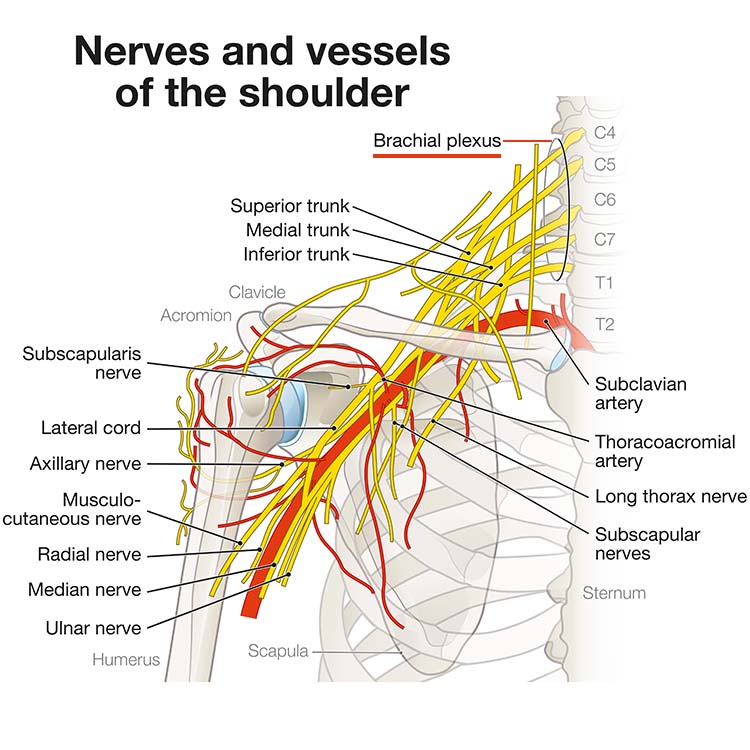

The brachial plexus consists of five nerve roots (C5-T1) that extend from the spinal cord. These nerves are responsible for:

  • C5 and C6: Shoulder movement and elbow bending
  • C7: Wrist movement and elbow straightening
  • C8 and T1: Hand and finger movements

Damage to these nerves can range from mild stretching to complete separation from the spinal cord (avulsion).

Causes of Brachial Plexus Injuries

Common causes include:

  • Traumatic accidents, like falls or sports injuries
  • Prolonged or complicated labor
  • Large birth weight

Symptoms of Brachial Plexus Injuries

Symptoms vary depending on the severity of the injury and may include:

  • Weakness or paralysis in the arm or hand
  • Reduced movement or sensation
  • An arm that hangs limply or cannot move
  • Drooping eyelids or difficulty breathing in severe cases

Treatment Options at Rady Children’s Hospital

Our expert team provides personalized care for children with brachial plexus injuries. Treatment options include:

Non-Surgical Treatments

  • Occupational Therapy: Focuses on improving range of motion, muscle strength, and joint flexibility.
  • Home Exercise Programs: Families receive guidance to support recovery at home.
  • Therapeutic Taping and Splinting: Encourages proper positioning of the arm and hand.
  • Botox Therapy: Temporarily weakens overactive muscles to restore balance and allow weaker muscles to strengthen.

Surgical Treatments

  • Microsurgical Nerve Repair: Recommended if there is no shoulder or elbow function by six months of age.
  • Nerve Transfers: Redirects healthy nerves to restore function in damaged areas. Recommended between 6-9 months of age.
  • Tendon and Muscle Transfers:  Improves mobility by repositioning tendons or muscles. Usually done later in childhood as needed.
  • Osteotomies: Adjusts bone positioning to enhance function. Typically performed later in childhood as needed.
  • Free Muscle Transfers: Involves transplanting muscles to replace damaged ones in severe cases.

Our Multidisciplinary Team

Our multidisciplinary team brings together experts from various specialties such as Rehabilitation Medicine, Orthopedics, and Occupational Therapy to provide the most effective care for children with brachial plexus injuries. These professionals have extensive experience managing complex nerve injuries and have treated hundreds of children with brachial plexus palsy.

Our Team Includes:

  • Pediatric Upper Extremity Surgeon: Specializing in surgical interventions such as nerve repair, transfers, and reconstructive procedures.
  • Occupational & Hand Therapists: Helping children regain strength, mobility, and functional independence through personalized therapy.
  • Rehabilitation Medicine Physician: Overseeing non-surgical care, coordinating treatment plans, and supporting long-term recovery.
  • Physician Assistant: Assisting in clinical evaluations, treatment coordination, and follow-up care.
  • Care Coordinator: Ensuring seamless communication between families and specialists to provide comprehensive support.

Meet Our Experts:

  • Michael Kwon, M.D., Associate Clinical Professor of Orthopedic Surgery, UC San Diego
  • Kate Hinchcliff, M.D., Associate Clinical Professor, Hand and Upper Extremity Surgeon, UC San Diego
  • Susan Biffl, M.D., Associate Clinical Professor of Orthopedic Surgery, UC San Diego
  • Amanda Asaro, P.A.-C – Physician Assistant
  • Denise Hoover, OTR/L, CHT – Occupational/Hand Therapist
  • JD McCrossin, R.N. – Care Coordinator

Why Early Intervention Matters

Timely evaluation and treatment are crucial. Untreated nerve damage beyond 18 months may result in permanent muscle weakness. Early care supports optimal recovery and developmental outcomes.

Partnering with Families

At Rady Children’s Hospital, we empower families through education and resources, ensuring they feel confident in supporting their child’s recovery. From advanced therapies to compassionate care, we are committed to helping children regain function and thrive.

Frequently Asked Questions (FAQs)

What is the brachial plexus?
The brachial plexus is a term used to describe a person’s nerves as they exit the spine in the neck region and progress toward the arm. A complex interweaving occurs in this area as the small individual nerve roots intermingle, reorganize and ultimately become the large nerves proceeding down the arm.
What is brachial plexus palsy?
Brachial plexus palsy may be suspected by an obstetrician or pediatrician in a newborn infant if both arms do not have similar strength. This is most often seen as one arm or hand being limp while the child is moving the other about. The cause of brachial plexus palsy is thought to be related to a stretching event that occurred around the time of birth. Most frequently this condition is seen in children who were born vaginally, were large and had a difficult delivery. There have been reports of brachial plexus palsy occurring in children delivered by Cesarean section, although this is rare. The exact cause being different in each case.
Is a limp arm always the result of a brachial plexus injury?
No. The most common cause of a limp arm in a newborn is a fracture of the clavicle, or collarbone. These tend to heal remarkably quickly by simply pinning the baby’s sleeve to their shirt as a sling. Almost always the child begins using their arm normally as the discomfort from the fracture fades with healing. Another common cause of a limp arm at birth is a fracture of the upper arm, the humerus. This also is treated with splinting for comfort, and tends to heal quickly.
How often does brachial plexus palsy occur with births?
The incidence of brachial plexus palsy is about 0.5-1.5 for every 1,000 babies born.
What tests should be performed for diagnosis and planning for patients with brachial plexus palsy?
The most important test is a careful physical examination. This information, compared with prior or future examinations, is the most important piece of information. Magnetic resonance imaging (MRI) studies of the neck area can be performed but should be reserved for preoperative planning if specific questions exist prior to undertaking possible nerve surgery. Similarly, electromyography (EMG) can be helpful at times, but can also be misleading. Physical examination remains the most critical of all the tests.
What can be done to improve the healing process?
The majority of brachial plexus palsy cases heal spontaneously, with no intervention at all. At first, simply resting the arm for comfort is the best thing; the healing process may take anywhere from weeks to months or more. Early referral to therapy is beneficial to prevent tightness from developing, but will not speed up the recovery. Patients who are slow to heal may benefit from surgical interventions. Several time points during development have recently been shown to be important to keep track of, as different paths of treatment may need to be pursued:

  • For cases in which the child has developed good strength to bend the elbow in the first two months of life, a full or very near full recovery should be anticipated over the next several years.
  • If the child reaches 5-6 months of age and still has significant weakness in bending the elbow, microsurgical exploration/repair of the nerves is warranted. Children with good strength at the elbow by this age have not been shown to benefit from this early surgery, compared to therapy and observation alone.
  • Regardless of the path chosen, infants with significant elbow weakness at 6 months of age are anticipated to have some permanent limitations in strength and motion of that arm.

Some doctors recommend operating on my child’s nerves by three months of age to guarantee the best recovery possible; why shouldn’t I do this?
Peer-reviewed, published quality research studies have shown that, at 5-6 months of age, the nerve surgery should be considered. There are many children who are still very weak at age 3 months is made, but who are much stronger at 5-6 months of age and don’t need the surgery. Those children would have had unnecessary surgery to achieve the same result by a year or two of age. There are ongoing investigations to attempt to refine these recommendations to be as accurate as possible.
If my child can bend her elbow well at 6 months of age, am I assured 100 percent recovery?
Unfortunately, no. Many children who have excellent function of their hands and good function of their elbows still develop significant problems with their shoulders. The most common pattern seen is an inability to turn the arm away from the chest (external rotation) and to elevate the arm above the shoulder (flexion). These limitations, or contactures,  will result in early and permanent deformity in the shoulder region if left untreated.
What treatment is appropriate for the shoulder problem?
Because the infant cannot move the arm normally, the shoulder may become tight when moving in certain directions. Early therapy and a parent home program with gentle daily stretching will minimize this tightness.If tightness is significant, the physician may recommend surgery to loosen the structures which are restricting motion of the shoulder, releasing the subscapularis muscle and the shoulder capsule. The physician will determine the best technique and best age to perform this surgery.In many cases, simply improving motion of the shoulder will not be sufficient. If the child does not have the strength to move his arm though the range of motion available, motion will eventually be lost again. For these patients, a surgery that moves muscles of the shoulder region, which are strong to a new position, replacing a muscle, which is weak, should be considered. Then most common of these surgeries is to transfer the Latissimus dorsi and Teres major muscles from the front of the shoulder to the back to improve external rotation. This surgery is often combined with that to relax the contracted front musculature and capsule.Following these surgeries, the patient is placed into a special cast to hold the arm in an externally rotated position. Further therapy begins as the cast is removed in stages.Another shoulder procedure which may be appropriate is called a humeral osteotomy. The goal of this surgery is to redirect the upper arm, resulting in the forearm aiming forward, not tightly across the chest. The patient who may benefit from this surgery is usually an older child or one in which deformity of the shoulder joint has already occurred.
What about the elbow and hand problems?
Occasionally, deformities occur in which the elbow does not straighten completely and the hand is turned upward (supinated). These can be partially corrected with surgery to redirect an elbow tendon. The correction is never to achieve normal function, rather to maximize functional abilities of the affected extremity.Hand deficits are extremely difficult to improve in the patients with brachial plexus palsy, since often there are very few muscles which are working at that level. Treatment is always recommended on a case-by-case basis, due to the unique nature of each problem.

Contact Us

If your child has experienced a brachial plexus injury, early evaluation is key to their recovery. Consultations with our multidisciplinary team, including pediatric upper extremity surgeons are available.

Rehabilitation / Physical Medicine – Contact: 858-966-8974

Orthopedic Injury Clinic – Contact: 858-966-6789

Appointments

Requesting an Appointment

If your child has had a brachial plexus injury, early evaluation is key to their recovery. Our multidisciplinary team, including pediatric upper extremity surgeons, offers consultations.

  • Appointments: Call our Orthopedic Injury Clinic at 858-966-6789.
  • Therapy (Rehabilitation / Physical Medicine): Call 858-966-8974.
  • Location: Rady Children’s Hospital-San Diego, Medical Office Building, 3030 Children’s Way, Suite 301, San Diego, CA 92123

For Providers

To refer a patient or ask a question about a referral, call 858-966-6789 or fax 858-966-8519.