


The Aerodigestive Esophageal Program at Rady Children’s
A child born with EA and TEF has more than one problem to solve. The airway, the esophagus, and the way your child feeds and breathes are all connected, and a change in one can affect the others. Care that treats each problem separately can miss how they connect.
Rady Children’s built the Aerodigestive Esophageal Program around that reality. Your child is cared for by one team:
- Pediatric surgery — repairs the esophagus and manages surgical follow-up
- Otolaryngology (ENT) — cares for the airway, voice and swallowing
- Pulmonology — manages breathing, chronic cough and respiratory infections
- Gastroenterology — manages reflux, strictures and esophageal function
- Speech-language pathology — evaluates swallowing and communication
- Occupational therapy — supports feeding skills and daily development
- Nutrition — tracks growth and adjusts nutrition over time
These specialists see these children together, review them together and build one plan together.
Your child’s team is part of our Center for Pediatric Aerodigestive Disorders and Airway Surgery. So your family has the center’s full airway team behind you. We care for your child from birth through the teen years and into adult life.
How Our Team Works Together
Children with EA and TEF have needs that cross several specialties at once — an airway, an esophagus, and feeding and growth that depend on both. Because these areas affect one another, the specialists caring for your child review them together rather than separately.
What one specialist finds helps the others. What pulmonology sees in the airway guides what gastroenterology looks for in the esophagus. What the feeding team notices at meals helps both. The team reviews your child’s history and tests together, then makes one plan.
Care is coordinated by our Aerodigestive Nurse Care Coordinator, who serves as your point of contact and can reach any member of the team between visits.
Three Specialists, One Procedure
Sometimes your child’s airway and esophagus need a closer look. We do this with a triple scope. ENT, pulmonology and gastroenterology all check your child at the same time, while your child is asleep. That means one procedure instead of three.
Three flexible or rigid scopes are used to assess your child’s anatomy, take cultures from the lower airways and perform biopsies of the upper digestive tract. Each specialist sees the findings as they happen and can discuss them with the others in the moment.
For children with EA and TEF, who may need this kind of evaluation repeatedly over many years, doing it as one coordinated procedure means fewer hospital days and fewer times your family has to prepare for a procedure. Learn more about the triple scope and our other procedures.
Conditon Overview
Esophageal atresia (EA) and tracheoesophageal fistula (TEF) are birth defects that affect the esophagus, the tube that carries food from the mouth to the stomach, and the trachea, or windpipe.
In EA, the esophagus does not form as one connected tube. Instead, it ends in a pouch and does not connect normally to the stomach. In TEF, there is an abnormal connection between the esophagus and the trachea. These conditions can affect a baby’s ability to breathe, swallow and feed safely.
Rady Children’s Hospital San Diego cares for children with EA and TEF at every stage — from prenatal consultation, when the condition is found before birth, through newborn surgery and into adult life.
Types of Esophageal Atresia and Tracheoesophageal Fistula (EA/TEF)
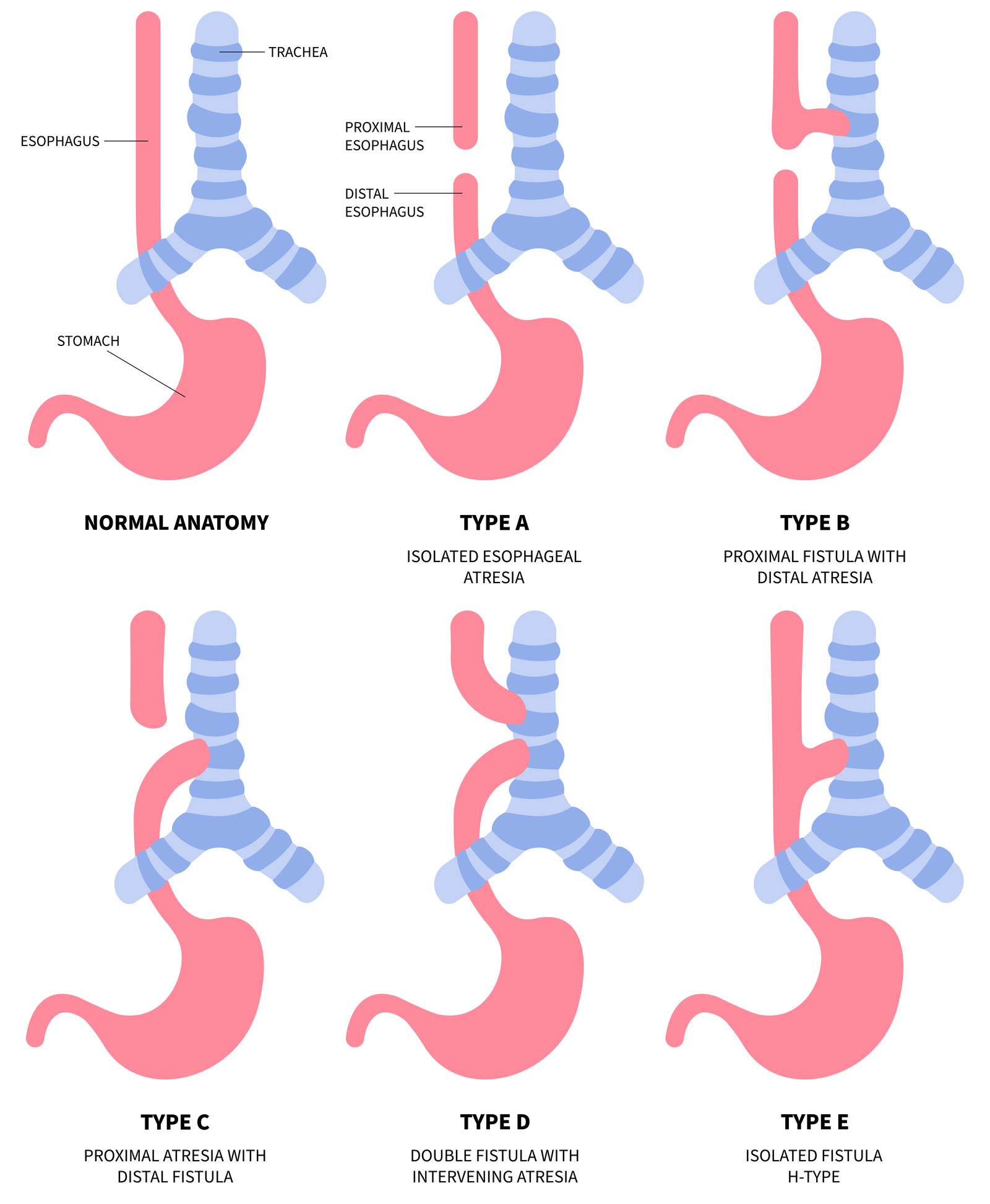
Doctors describe EA and TEF by type, based on where the esophagus ends and whether it connects to the windpipe. Your child’s care team will explain which type your child has and what it means for their treatment.
- Type A — isolated esophageal atresia. The esophagus ends in a pouch at the top and begins again lower down, with no connection to the windpipe. About 8 in 100 cases.
- Type B — proximal fistula with distal atresia. The upper part of the esophagus connects to the windpipe, and the lower part ends in a blind pouch. Rare, about 1 in 100 cases.
- Type C — proximal atresia with distal fistula. The upper esophagus ends in a pouch and the lower esophagus connects to the windpipe. This is the most common type, about 85 in 100 cases.
- Type D — double fistula with intervening atresia. Both the upper and lower parts of the esophagus connect to the windpipe. Rare, about 1 in 100 cases.
- Type E — isolated fistula, also called H-type. The esophagus is fully formed and reaches the stomach, but an abnormal passage connects it to the windpipe. About 4 in 100 cases.
Signs and Diagnosis
Nearly 90 percent of babies with EA also have TEF. Together, these conditions affect about 1 in every 2,500 to 5,000 births. They develop early in pregnancy, usually between 4 and 8 weeks, when the esophagus and trachea do not separate as expected. In most cases, the cause is unknown.
The most common form is type C, in which the upper esophagus ends in a pouch and the lower esophagus connects to the windpipe. Common signs in newborns include:
- Excessive drooling
- Choking, gagging or coughing during the first feeding
- Bluish skin color, called cyanosis, especially during feeding
- A swollen belly
Doctors may diagnose EA or TEF before birth or shortly after delivery. Before birth, an ultrasound may show extra amniotic fluid, called polyhydramnios, or a small or absent stomach bubble. After birth, the diagnosis is often confirmed by trying to pass a small tube through the baby’s nose or mouth into the stomach. If the tube cannot reach the stomach, an X-ray can confirm the blockage.
Other Conditions We Check For
About half of babies with EA and TEF have other birth differences. These may be part of a group of conditions called VACTERL association. Each letter stands for an area that can be affected: V for vertebrae (spine), A for anus, C for cardiac (heart), TE for trachea and esophagus, R for renal (kidneys) and L for limbs (arms or legs).
Your baby’s care team may recommend additional tests to check for these conditions, such as an echocardiogram (heart ultrasound), a kidney ultrasound or spine X-rays.
Surgery and Hospital Care
EA and TEF usually require surgery in the first few days of life. Your child’s surgeon will explain the approach that is best for your baby and what to expect at each stage.
The Goals of Surgery
Surgery has two goals:
- Close the abnormal connection, called a fistula, between the esophagus and the windpipe
- Reconnect the two ends of the esophagus so food can travel to the stomach
How the Repair Is Done
The repair may be done in one of two ways:
- Open surgery. The repair is done through a small incision in the chest.
- Minimally invasive surgery. The repair is done with a camera and small instruments. This is also called thoracoscopic surgery.
When the Gap Is Too Long
In some babies, the gap between the two ends of the esophagus is too long to connect right away. These babies may need a staged approach over weeks to months, which can include:
- A temporary feeding tube placed directly into the stomach, called a gastrostomy
- Procedures to gradually stretch the two ends of the esophagus until they can be joined
- In rare cases, rebuilding the esophagus using a piece of the stomach or intestine
After Surgery
Your baby will be cared for in the neonatal intensive care unit, or NICU. The care team will:
- Monitor your baby’s breathing and provide support if needed
- Begin feedings slowly, often through a small tube that passes through the surgical connection into the stomach, before your baby moves to feeding by mouth
- Watch for a leak at the surgical site, which happens in about 20 percent of cases and usually heals on its own
- Watch for narrowing, called a stricture, where the esophagus was repaired
Lifelong Care, From the NICU to Adulthood
Survival rates for children with EA and TEF are now greater than 90 percent. Even after successful surgery, these are lifelong conditions, and children often need ongoing care as they grow.
The same team that cares for your newborn in the NICU continues to follow your child through childhood, adolescence and the transition to adult care. Each area of your child’s health has a specialist watching it, and those specialists talk to one another.
- Airway health. Pulmonology and ENT monitor for tracheomalacia, a floppy windpipe that can cause noisy breathing, increased work of breathing, a barking cough or frequent respiratory infections. Most children’s airways develop the ability to compensate, though some need additional treatment, including tracheopexy, a procedure that supports the windpipe.
- Esophageal health. Gastroenterology and pediatric surgery watch for two common concerns. A stricture is a narrowing where the esophagus was reconnected; it is treated by gently widening the area with a balloon or dilator during an endoscopy. Strictures that are harder to treat may need endoscopic incisional therapy (EIT), where small cuts are made in the scar tissue to open the narrowed area. Gastroesophageal reflux disease, also called GERD, happens when stomach acid flows back into the esophagus; it is often managed with medication and changes to diet, and some children need surgery to prevent further reflux.
- Feeding and swallowing. Our feeding and swallowing team, speech-language pathologists and occupational therapists work with children who have dysphagia, or difficulty swallowing. Children may eat slowly, need to drink water with meals or occasionally have food get stuck. Cutting food into small pieces and chewing thoroughly can help, and a feeding therapist can evaluate your child’s skills and build a plan for their needs.
- Growth and nutrition. Our nutrition team tracks growth and adjusts the plan as your child’s needs change.
Regular follow-up helps the care team identify and treat concerns early, especially as your child grows into a teenager and adult. It also helps to tell your child’s school, daycare and caregivers about their condition and any dietary needs.
Tracheomalacia Care and Tracheopexy
Airway health is one of the areas our team follows for life, and tracheomalacia is the concern that comes up most often for children with EA and TEF. Because families ask about it so frequently, it is worth explaining in more detail.
Tracheomalacia is a floppy windpipe. The trachea is held open by rings of cartilage. When that cartilage is soft or did not form normally, the airway can partly collapse — most often when your child breathes out, coughs or cries.
Why It Is Common in Children With EA and TEF
The trachea and the esophagus form from the same structure early in pregnancy. When they do not separate as they should, the cartilage in the windpipe is often affected as well. That is why many children with EA and TEF have some degree of tracheomalacia. It is not a complication of surgery — it is part of the same difference in how the airway and esophagus formed.
What Parents Notice
- A harsh, barking or seal-like cough
- Noisy breathing, especially when breathing out, crying or feeding
- Difficulty clearing mucus
- Chest infections that take longer than expected to clear
- In more severe cases, brief episodes of breath-holding or colour change, often around feeding
How It Is Diagnosed
Tracheomalacia has to be seen as it happens. It is diagnosed with a flexible bronchoscopy while your child is breathing on their own, so the team can watch how the airway behaves through the whole breathing cycle. A single still image or scan can miss it.
At Rady Children’s, this airway evaluation is often done as part of the triple scope, so ENT, pulmonology and gastroenterology each assess your child during a single procedure rather than three separate ones.
How It Is Treated
For most children, time is the main treatment. Cartilage becomes firmer as children grow, and many improve significantly over the first years of life. Care during that period focuses on treating chest infections promptly, helping your child clear secretions, and monitoring breathing as they grow.
A smaller number of children have symptoms severe enough to need more than supportive care. For them, tracheopexy is a surgical option. Rather than placing a tube or stent inside the airway, the surgeon repositions and secures the trachea so that it stays open.
When to Seek Medical Help
It is important to learn the signs that food may be stuck in the esophagus, which needs medical attention:
- Refusing to eat
- Drooling more than usual
- Chest discomfort
- Poor weight gain or growth
Call your child’s care team if your child has trouble swallowing or shows any of the signs above.
Go to the emergency room if your child:
- Has food stuck in the esophagus that does not pass after drinking water
- Has trouble breathing, wheezing or a persistent cough
- Vomits repeatedly or cannot keep food down
- Has a fever with coughing or breathing problems
Frequently Asked Questions
Will we need separate appointments with each specialist?
No. Your child is seen in one longer appointment with the full team. You tell your child’s story once and leave with a single agreed care plan rather than several separate opinions to reconcile.
Do the specialists actually talk to each other, or do I have to pass information between them?
They review your child together. During procedures such as the triple scope, ENT, pulmonology and gastroenterology are present at the same time and discuss findings as they happen.
Who do I call between visits?
Our Aerodigestive Nurse Care Coordinator is your point of contact and can reach any member of the team.
How long will my child need to be followed?
EA and TEF are lifelong conditions. We follow children through childhood and adolescence, and help them transition to adult providers who understand their history.
What is a triple scope, and why is it done that way?
It is an evaluation of the airway and upper digestive tract performed by three specialties at the same time under a single anesthetic, which means fewer procedures and fewer anesthetics for your child over the years.
What is tracheopexy?
Tracheopexy is a procedure that supports a floppy windpipe, a condition called tracheomalacia that is common in children with EA and TEF. Instead of placing a tube or stent inside the airway, the surgeon repositions and secures the trachea so that it stays open. See Tracheomalacia Care and Tracheopexy above for more detail.
Meet the Team
Our Aerodigestive EA and TEF Clinic team includes specialists in ear, nose and throat, pulmonology, gastroenterology and pediatric surgery who partner on your child’s care.

Matthew Brigger, M.D., M.P.H., Chief, Division of Otolaryngology (ENT); Surgical Director, Aerodigestive Program; Professor of Surgery, UC San Diego

Aparna Rao, M.D., Pulmonology & Respiratory Medicine; Medical Director, Aerodigestive Program; Professor of Pediatrics, UC San Diego

Andrew Dickerson, M.D., Gastroenterology, Hepatology & Nutrition; Assistant Clinical Professor of Pediatrics, UC San Diego

Kyle M. Thompson, M.D., Pediatric Surgery, Rady Children’s Specialists of San Diego
Request an Appointment
Access our referral forms below to request an appointment at Rady Children’s Hospital. If you have any questions, please contact our Center for Pediatric Aerodigestive Disorders and Airway Surgery Nurse Coordinator at 858-966-1700 ext. 223403.
Contact Us
Center for Pediatric Aerodigestive Disorders and Airway Surgery
Rady Children’s Hospital
Otolaryngology Clinic, Medical Office Building, 1st Floor
3030 Children’s Way, San Diego, CA 92123
Tel: (858) 966-1700 ext. 223403
Fax: (858) 966-7852
Email: RadyAerodigestive@rchsd.org