
Girl Scouts: Girl Scout Autism Awareness Patch
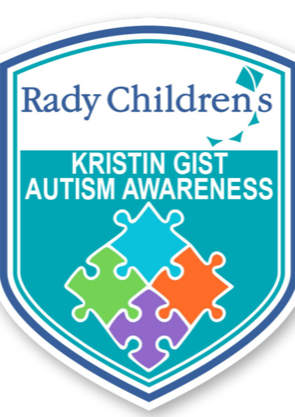
Rady Children’s Hospital Kristin Gist Patch for Autism Awareness
We are pleased to offer the opportunity for Girl Scouts to learn more about autism spectrum disorders through self-completion of the Kristin Gist Autism Awareness Patch.
- Who: Brownies–Ambassadors
- What: Kristin Gist Autism Awareness Patch
- When: Self-Guided Patch Program
- Where: 3020 Children’s Way, MC5010, San Diego, CA 92123
- Cost: Patches are free with completion of age-appropriate activities.
- Contact: For more information or to receive a patch, contact Julie Purdy: jpurdy@rchsd.org or 858-966-5408
The Facts
One in every 36 children in the United States has a diagnosis of autism. While it affects many people, autism and the behaviors that accompany it may not be well understood.
Children with autism face unique challenges. Though each child might have different symptoms, the most common include speech and language differences, having trouble understanding social cues, difficulty making and keeping friends, narrow or fixated interests, and repetitive behaviors. Even children without autism may experience some of these symptoms or behaviors during their lives. By completing the activities for this patch, you should be able to recognize how to understand these behaviors in others and how you may have things in common with children who have autism.
The Activities
To complete this patch, all of the * items must be completed for each section (Discover, Connect, Take Action and Reflect).
Discover Activities
- * With your troop/group/family, read one book from the list on page 5. What did you learn? Share what you learned with a parent, teacher or trusted friend.
- * What do these terms mean? You might have heard them used in conversation, but do you really know what they mean? Look up the following terms in a dictionary or on a computer. All levels must look up the starred items. All but Daisy/Brownies must look up the rest of the terms.
- A. *Autism
- B. *Neurodiversity
- C. Social Skills
- D. Repetitive Behaviors
- E. Sensory Processing
(Write your definitions below.)
- * Many children with autism are very sensitive to certain textures or sensations. Some children really enjoy these sensations (e.g. wet textures on hands, chewy foods, certain fabrics), while other children with autism have a very difficult time tolerating them. Sensory play activities may help children with autism explore these feelings. Try one yourself. Did you enjoy it? How did these activities make you feel?
A. Dr. Seuss’s Oobleck (From Bartholomew and the Oobleck)
- Mix together one cup of cornstarch, one cup water and one or two drops of food color.
- Let the Oobleck drip off of your fingers, form a ball, watch it turn back into slime. How does it feel dripping from your fingers? (Source)
B. Tasting Game
- Ask a parent to pick a few foods that might be new to you or something you don’t have often. While blindfolded, let the adult feed you a small amount of the food and guess what it is. Does food taste differently while blindfolded? (Source)
C. Ice Cube Drawing
- Put a small amount of acrylic paint or food color into different portions of an ice cube tray. Fill the rest with water and add a popsicle stick, propping the stick up with foil until it freezes.
- Remove the colored popsicles and paint a picture on a piece of paper. How does it feel to paint with something so cold? (Source)
Connect Activities
- * Choose at least one of the following activities:
A. Song Time
Some children with autism cannot speak. Think of all the things you can say with your words. What if you weren’t able to use those words? How would you communicate with facial expressions, or gestures, or even music or humming? With at least one other person, try communicating an emotion by using non-verbal cues. Take turns guessing what emotion the other person is trying to convey. (Source)
B. Bullying
Many children are bullied. Some children with autism may be bullied because they have a difficult time understanding and following social cues. Many of us face bullying, and this is something we can work together to end. Play one of the games listed below:
- A Safe Pair of Hands Game: Get together a group of friends and play “A Safe Pair of Hands.” Each person writes a time they have been bullied. Papers are mixed up and placed upside down in the center. Each person takes a turn picking one, and the group offers supportive suggestions starting with: “I can lend you a hand. Would it help if you/I/we…?”
- The Anger Suit: Find an old jacket or hat. Take turns putting it on and acting out a bullying situation where you are the bully. Others guess what is happening and discuss where you could go for help if a bully treated you that way.
- * Choose one activity from your age level below. Many children with autism process sensory information differently. Sounds or sights can become overwhelming. When this happens, a break can help. Try one of the activities below to see if it helps calm you when you feel overwhelmed.
Daisy/Brownie
- Blowing bubbles: Take deep, slow breaths, and exhale steadily to fill the bubble. Pay attention to the bubbles as they form and float away.
- Pinwheels: Take deep, slow breaths and exhale steadily. Notice how your breath causes the pinwheel to turn.
- Balloons: Keep a balloon off the ground, moving slowly and gently. Pretend it is very fragile.
- Texture bag: Have someone put small textured objects in a bag. Reach in and describe what you feel without looking. (Source)
Juniors/Cadettes
Try one of the following two activities that help you become more aware of your body and more present in the moment:
A. Body Scan
- Lie down on your back on a comfortable surface and close your eyes.
- Squeeze every muscle in your body as tight as you can.
- Squish your toes and feet, squeeze your hands into fists, and make your legs and arms as hard as stone.
- After a few seconds, release all your muscles and relax for a few minutes.
- Think about how your body is feeling.
B. Heartbeat Exercise
- Jump up and down in place or do jumping jacks for one minute.
- Sit down and put a hand over your heart.
- Close your eyes and pay attention only to your heartbeat.
- Take slow, even breaths. (Source)
Senior/Ambassador
A. Try an app
- Stop, Breathe, and Think: Web and mobile app with meditations for mindfulness and compassion
- Calm.com: Free website and mobile app with guided meditation and relaxation exercises
- Insight Timer: Free mobile app with virtual “bells” and many guided meditations
- Headspace: “Meditation made simple.” Free intro period, then paid subscription
- Breathr: Free mindfulness app for youth
B. Mindfulness Walk or Safari
- Go on a walk with a goal to notice as many birds, bugs, and animals as you can.
- Try to focus only on animals and ignore other people, cars, or man-made items.
- Take slow deep breaths as you walk. (Source)
Take Action Activities
Many people do not really understand autism and this makes it much more difficult for a classmate with autism to interact with others. * For Take Action, pick one of the following items and make a difference:
- Educate someone else by sharing what you have learned with a friend, Girl Scout troop, or school classroom.
- Realize that language matters. Read an article that discusses identity-first vs person-first language and talk with someone about it. (Source)
- Help make sure books like the ones on this list are available in your school or local library (ask a librarian/teacher or donate a book).
- Create your own action project. What will you do to make a difference?
Reflection Activities
* For Reflection, pick one of the following items:
- Create a journal and track a goal for using one technique you learned for at least a month.
- Write a story, choreograph a dance, or create a drawing to express what you learned.
- When you feel overwhelmed, use one Connect activity for at least a month. Did it help?
- Based on what you learned, try something new. Why did you pick it and what did it teach you?
Book List
Ages 4–8 (Daisy/Brownies)
- A Friend like Simon by Kate Gaynot (ages 3–6)
- A Manual for Marco: Living, Learning, and Laughing with an Autistic Sibling by Shaila Abdullah (ages 3–6)
- Crow Boy by Taro Yashima (ages 3–6)
- A Boy Called Bat by Elana Arnold (ages 6–9)
- A Friend for Henry by Jenn Bailey (ages 6–9)
- Benji, the Bad Day and Me by Sally J. Pla (ages 6–9)
Ages 8–13 (Juniors/Cadettes)
- A Whole New Ballgame by Phil Bildner (ages 9–12)
- Al Capone Does My Shirts by Gennifer Choldenko (ages 9–12)
- Anything But Typical by Nora Raleigh Baskin (ages 9–12)
- Autism, the Invisible Cord: A Sibling’s Diary by Barbara S. Cain (ages 9–12)
- Can You See Me? by Libby Scott & Rebecca Westcott (ages 9–12)
Ages 13+ (Seniors/Ambassadors)
- In Two Worlds by Ido Kedar (teen)
- Somebody, Please Tell Me Who I Am by Harry Mazer and Peter Lerangis (teen)
- The Curious Incident of the Dog in the Night-Time by Mark Haddon (teen)
- The Sound of Letting Go by Stasia Ward Kehoe (teen)
- Marcelo in the Real World by Francisco X. Stork (teen)
This patch was developed by the Developmental Services division of Rady Children’s Hospital to honor Kristin Gist, who has been an advocate for children with autism spectrum disorder for the past 35 years. Thank you, Kristin, for all you have done to provide services for children with autism.